
“Let a woman learn in silence with all submission. And I do not permit a woman to teach or to have authority over a man, but to be in silence” (NKJV).
The problem with this text is not what Paul said or how he directed the congregation of GOD. The problem lies in the way the text is translated. We must remember: Scripture interprets Scripture, and it will never contradict itself. With that being said, let’s get into the text. PAUL’S VIEW OF WOMEN First, let’s examine Paul’s view of women and their capabilities. Notice Galatians 3:28, where Paul speaks of equality among Christians: “There is neither Jew nor Greek, there is neither slave nor free, there is neither male nor female; for you are all one in Christ Jesus.” This is a powerful statement. Here, Paul affirms that between men and women, our spiritual standing, access to GOD’s grace, and identity in Christ triumph over all earthly social, cultural, and gender hierarchies. While women’s equality and leadership roles have grown tremendously in society, women still face disproportionate hurdles—especially in the church. Religion, in practice, has created distinct, multi‑layered barriers for women who are fully qualified for upper‑management and supervisory roles. In many modern churches, institutional hierarchies and cultural norms have created obstacles that limit qualified women from leading or serving in pastoral roles. This is how many churches and church leaders interpret Paul’s words in 1 Timothy 2:12 and 1 Corinthians 14:34. They insist that women are restricted—or even disqualified—from operating in senior pastoral offices, teaching adult men, or holding positions that allow them decision‑making authority over the congregation of GOD. Even when a woman becomes an ordained minister, she is often placed in roles such as Children’s Ministry, Prayer Ministry, Street Team Ministry, Associate Minister, or Christian Education, while being overlooked for senior pastoral and executive positions. These roles continue to be heavily dominated by men. In addition to these disparities, female ministers often face significant pay inequality compared to their male counterparts. Yet statistics show that women historically perform the vast majority of congregational labor. Women are known for leading church activities such as organizing events, managing care ministries, overseeing logistics, teaching Sunday school, managing people and programs, organizing prayer meetings, and coordinating social events. And yet, they are often excluded from official elder boards, deacon bodies, or finance committees—where institutional governance decisions are made. In fact, modern churches often mimic traditional gender roles just as the world does today. This behavior stands in complete opposition to Paul’s point in Galatians 3:28. FEMALE LEADERSHIP UNDER PAUL This is a good place to look at a few women who operated under Paul’s leadership. Let me restate something I said earlier: Scripture interprets Scripture, and it will never contradict itself. Let’s discuss a few of Paul’s key co‑workers. Throughout Scripture, Paul highlights several prominent women who helped him care for and grow the congregation of GOD. Junia— Romans 16:7 In this verse, Paul greets Andronicus and Junia and refers to both as apostles. SIDEBAR: An apostle in the church falls under one of the following definitions:
Phoebe — Romans 16:1—2 Phoebe was tasked with delivering Paul’s letter to the Romans as a deacon in the church of Cenchreae. SIDEBAR: The word servant is the Greek word diakonos (G1249), meaning:
Priscilla — Acts 18:26 Contrary to Roman custom, Paul often placed Priscilla before her husband Aquila when addressing them. This reflected her prominent role as a teacher in the Corinthian congregation. Priscilla was so effective as a Bible teacher that Paul wrote about her correcting Apollos’s theology. She and her husband took Apollos aside and “explained to him the way of GOD more accurately.” Other Women in Ministry — Paul also praised Mary, Tryphena, Tryphosa, and Persis for their leading roles in ministry. Mutual Interdependence — 1 Corinthians 11:11-12 Here, Paul points out the mutual interdependence between men and women under GOD’s creation. GOD designed men and women to rely on each other to meet needs, achieve goals, and function effectively. Neither can fully succeed or operate smoothly without the support, input, direction, guidance, or cooperation of the other. When one attempts to usurp the mutual dependence of the other, they step outside GOD’s original design. We must remember: men and women’s outcomes are tied together according to creation. The actions of one directly impact the other. Simply put, both sides have something the other needs. There is no way around this according to Genesis chapters 1 and 2. When we go outside GOD’s plan, chaos occurs—as seen in Genesis chapter 3. 1 TIMOTHY 2:11—12 Let’s read 1 Timothy 2:11–12 again: “Let a woman learn in silence with all submission. And I do not permit a woman to teach or to have authority over a man, but to be in silence” (NKJV). To interpret these verses correctly, you must review the original 5th‑century Codex Alexandrinus text and be able to read Greek.  When most people read this passage, they interpret it literally — which is an error. When reading and interpreting this scripture, one must consider the culture, the environment, and what was happening at the time the writer penned the text. Bible students must also take into account the grammatical nuances. In this verse, there is a difference between instructing a person to be quiet versus commanding them to be absolutely silent. So which is it? Is Paul telling women to be quiet, or to be completely silent? And is he speaking to a specific group of women or to all women? Let’s look at the word silence used in verses 11 and 12:
When we examine the original Greek texts, we must determine the proper translation of the word silence. The Greek word used in verse 11 is hēsychia (G2271). This is the same word used in verse 2 to describe living a “quiet and peaceable life”: “For kings and all who are in authority, that we may lead a quiet and peaceable life in all godliness and reverence.” This word refers to one’s posture, a quiet spirit, or tranquility, rather than absolute muteness. Therefore, it is important to consider correct grammar, punctuation, and flow while keeping the author’s original voice and argument intact. So again: Did Paul definitively mean that women should keep silent and not teach in the congregation of GOD? Now let’s take a closer look at verse 12. Let me rephrase the question: In 1 Timothy 2:11–12, when Paul said that women should “be in silence,” did he mean absolute silence — as in muteness — and was he speaking to all women or a specific group? Again, the word silence in verse 12 follows the same Greek pattern as 1 Timothy 2:2. The Greek word used here is hēsychia, meaning quietness, tranquility, or a peaceable disposition, rather than absolute muteness. It does not refer to vocal silence. The Greek word for vocal silence is sigē, which is not used in this passage. When we accurately interpret the translated text according to its original meaning, we gain the correct grammatical nuance and flow. Therefore, it is accurate to understand that Paul was not asking all female believers to stop talking. Instead, he was instructing them to maintain harmony and avoid being disruptive during congregational gatherings. So, was Paul addressing all women or a specific group of women? Again, Scripture interprets Scripture, and it never contradicts itself. So let’s look at another passage to understand why Paul addressed this issue in 1 Timothy 2:12. Read 1 Timothy 5:13: And besides they learn to be idle, wandering about from house to house, and not only idle but also gossips and busybodies, saying things which they ought not. Here, Paul is speaking to Timothy—who is the overseer and young evangelist of this congregation in Ephesus—about the behaviors and qualifications of young women. The issues in this congregation centered around younger widows who had no family support. Widows sixty years and older were placed on an official church support list to receive financial and material care, provided they met strict moral and spiritual qualifications. Paul advised Timothy not to place younger widows on this official roll. He believed that doing so would lead some of them to become idle, wandering from house to house, gossiping, and being busybodies — saying things they should not. This behavior would create division, spread rumors, and disrupt the peace of both the congregation and the wider Ephesian community. So far, Paul is addressing younger widows of that specific era, not all women. The more serious concern was that such behavior would create an environment where opponents of the church could criticize it and discredit the Kingdom message. GODDESS DIANA (ARTEMIS)We must also consider the religious environment of Ephesus to understand Paul’s point in 1 Timothy 2:12 and identify which group of women he was addressing.
In Ephesus, the cult of Artemis (Diana) dominated the region. Diana was a female goddess, and women held supreme religious authority in her cult. Their pagan teachings claimed that woman was created before man — blasphemy, and a direct contradiction of Scripture and GOD’s order of creation. This is why Paul said to the Ephesian congregation: “I do not permit a woman to teach or to have authority over a man…” He was addressing the young women influenced by the Artemis cult, whose doctrine was corrupt. They were being taught false creation theology and were spreading it within the congregation. Paul clarifies this in 1 Timothy 2:13–14:
This was precisely the issue in Ephesus: young women were being deceived and falling into doctrinal error. This is why Paul did not permit them to teach the men — their teachings were corrupted by the cult of Artemis. This is why Paul told these young women to “be in silence”: their doctrine and understanding were distorted. Paul was not asserting superior value or intelligence, nor was he restricting women from holding pastoral or elder roles, nor from exercising authoritative doctrinal teaching over the congregation of GOD. Many in the modern church misunderstand this passage. Now, through this study, we have correction and new insight into this scripture. Paul was not mandating that women in the church be absolutely silent, nor was he speaking about all women from the first‑century church to today. The evidence throughout Scripture — including this passage — makes that clear. Paul commended female leaders across his epistles and used them in leadership roles as apostles, pastors, deacons, prophetesses, and administrators. Now that we have accurate information, it is up to us to decide whether we will submit to GOD’s Word through Paul — or cling to our own pride and traditions (2 Timothy 3:16). All Scripture is inspired and given by GOD. It is not interpreted by men according to their preferences; GOD determines its meaning.
0 Comments

America that we once knew is no more due to two factors.
Right now, we have too many members of the Church who are walking into darkness in and around the political arena because too many cannot hear accurately from GOD concerning the political agenda and affairs of the world, because too many of us have been programmed to believe there is a separation between Church and State. Therefore, we have believed the lie that Christians should not be openly involved in politics. LET’S TALK ABOUT IT! POLITICAL EFFORT TO ISLAMIFY THE UNITED STATES U.S. Congressman Chip Roy of Texas said it well at a recent Lower House meeting. He spoke about other individuals with whom he stood on stage, and how many of them on that stage had worn the U.S. uniform to fight for this nation against radical Islamic members who wanted to destroy this country and Western civilization. Then he explained the difference between fighting these forces in another country and fighting them today. He stated that even though we are fighting the same war against these radicals, today it is a war within the boundaries of the United States. They are attempting to destroy our country from within. [To watch Representative Chip Roy’s speech at the Lower House, click here]. SHARIA LAW I won’t spend a lot of time going over the ins and outs of Sharia Law. But we do need to touch basic information for this discussion. Sharia Law is the moral, ethical, and religious instructions that guide the lives of those who practice the Muslim faith. It covers anything from prayer, fasting, and dietary choices to business ethics, marriages, and community conduct. Its daily guidance comes from the Quran, which Muslims believe it comes directly from the words of their god. Why should all Americans, especially Christians, fight against the enactment of such a law? Because if implemented in the United States as national or state civil law, it would fundamentally alter America’s legal system, political environment, and daily life. The United States Constitution would no longer exist. Our First Amendment rights that prohibit the government from establishing an official religion would be overridden and repealed. Our freedom of worship would no longer be an option because we would be required to convert to the Islam faith or die. We will be required to know and live under the standards and traditions enforced by Sharia Law. The Holy Scriptures and all other religious content will not be allowed, and the Quran will become the official Bible. Freedom of speech will be eliminated because such expression would be deemed blasphemous and even apostasy. The list of laws and regulations would impact our entire life. This country will no longer be America, but a Muslim state, and all the freedoms as we know them today will be a thing of the past. HOW SHOULD CHRISTIANS RESPOND I need to quote one scripture here, and then we need to talk about what Jesus meant when He stated those words.
“And from the days of John the Baptist until now the kingdom of heaven suffers violence, and the violent take it by force.” The part we need to focus on in this verse is, “…the kingdom of heaven suffers violence, and the violent take it by force.” My brothers and sisters of the Christian faith, this day has arrived. We can no longer sit back idle and compromised in our faith and not respond to the political atmosphere and spiritual warfare that is occurring in our nation. Let’s come back to Matthew. We need to look at two more scriptures—Luke 19:13 and Matthew 28:19–20. It is ideal to read the entire chapters, but for the sake of this discussion, we will only look at specific verses. At Luke 19:13, it reads: And he called his ten servants, and delivered them ten pounds, and said unto them, Occupy till I come (KJV). The New King James Version reads, “…do business till I come.” After addressing His twelve disciples, Jesus went to teach and preach in the cities. At some point, Jesus turns His attention to the multitudes present and begins to speak about John the Baptist. When you read verses seven through thirteen, Jesus refers to the nonreligious system of John and the confrontational stand the Kingdom message of GOD makes by means of violence whenever it has to oppose human status quo. Jesus speaks of how GOD’s Kingdom message refuses to dance to the music of society’s expectations that are often dressed up in the name of religion or dead worldly (man‑made) traditions. We have to come to the understanding and acceptance that Jesus is speaking about political and military warfare in these few verses. (Also see Matthew 10:34–39; Luke 12:49–53; and John 18:36.) Now, let’s be clear. The upheaval of GOD’s Kingdom message spoken by Jesus is not caused by political provocation or armed advance. But it is a result of GOD’s divine shaking up relationships, households, cities, and nations by the power of Holy Spirit working through His people. This is what Jesus meant by His words when He said, “…occupy (or do business) till I come.” We as Christians are expected to use our resources, platforms, gifts, talents, authority, and anointing to keep ourselves busy doing all the necessary works of the Kingdom of GOD. This definitely does not describe someone sitting idle in a compromised state, waiting on the Lord’s return, especially when there are far too many lost souls and territories that are lost to the kingdom of darkness. There is obviously much work that needs to be done, which requires all Christians to occupy their respective regions until the Lord’s return. Matthew 28:19–20 puts it this way: Go therefore and make disciples of all the nations, baptizing them in the name of the Father and of the Son and of the Holy Spirit, teaching them to observe all things that I have commanded you; and lo, I am with you always, even to the end of the age. That simple word, “Go,” is such a powerful command to all of Jesus’ disciples. The Greek word for “Go” is poreuō, which means to lead or carry over, or to pursue. The Merriam‑Webster Dictionary defines it as to move in a particular way or direction, or for a particular purpose. I am sure our Lord God, Jesus Christ, did not raise up this country as a Christian nation only to see it fall to a radical nation like the Muslim faith because the church and its leaders failed to:
The uprising of the Muslim faith and the implementation of its master plan—their Brotherhood Plan—to take down America is because:
 ·Matthew 27:1-10 ·The Plot ·What Can We Learn Very early in the morning the leading priests and the elders of the people met again to lay plans for putting Jesus to death. Then they bound him, led him away, and took him to Pilate, the Roman governor. When Judas, who had betrayed him, realized that Jesus had been condemned to die, he was filled with remorse. So he took the thirty pieces of silver back to the leading priests and the elders. “I have sinned,” he declared, “for I have betrayed an innocent man.” “What do we care?” they retorted. “That’s your problem.” Then Judas threw the silver coins down in the Temple and went out and hanged himself. The leading priests picked up the coins. “It wouldn’t be right to put this money in the Temple treasury,” they said, “since it was payment for murder.” After some discussion they finally decided to buy the potter’s field, and they made it into a cemetery for foreigners. That is why the field is still called the Field of Blood. This fulfilled the prophecy of Jeremiah that says, “They took the thirty pieces of silver-- the price at which he was valued by the people of Israel, and purchased the potter’s field, as the Lord directed.” (Matthew 27:1-10, NLT). Okay, we have read Matthew 27:1–10. Let’s analyze what took place during this plot and determine what we can learn from it. THE PLOT In verse 1, the chief priests and elders of the people plotted to have Jesus murdered. They sketched out an entire calculated plan. Step 1: They had Jesus arrested and placed before the Roman governor, Pilate. This was necessary because the Jewish leaders could not legally execute anyone; Rome had removed their right to enforce capital punishment. Only Pilate could issue a death sentence. Step 2: They needed a patsy to help set Jesus up. That patsy was Judas Iscariot (Matthew 26:14–16). Step 3: Judas selected the best opportunity to betray Jesus and handed him over to the multitude of men sent by the chief priests and elders (Matthew 26:47–56). Once Jesus was taken into custody, he was presented before Caiaphas, the high priest, along with the scribes and elders (Matthew 26:57–58). While in custody, this council sought false testimony against Jesus so they could legally put him to death, but none was found (Matthew 26:59–60). Step 4: They put Jesus through a preliminary trial to determine how they could legally charge him with a crime deserving death (Matthew 26:60–68). After holding the preliminary trial, the next day Caiaphas, along with the chief priests and elders, bound Jesus and led him to Pontius Pilate (Matthew 27:1–2). Step 5: The official trial began (Matthew 27:11–13). In verses 15–25, an interesting exchange took place between the people, the chief priests, the elders, and Pilate. Pilate presented Jesus—an innocent man accused of insurrection and blasphemy—next to Barabbas, an actual insurrectionist. Pilate asked the crowd, “Whom do you want me to release to you? Barabbas, or Jesus…” (Matthew 27:15–17). Pilate knew the chief priests and elders were envious of Jesus (Matthew 27:18). Their envy fueled their plot to murder an innocent man. Then Pilate’s wife interrupted the hearing to warn him. She had a dream concerning Jesus and realized He was innocent. She understood the religious leaders were trying to take the life of a righteous man. She told her husband, “Have nothing to do with this man, for I have suffered many things today in a dream because of Him” (Matthew 27:19). Step 6: In the final stage of the trial, to ensure Jesus was convicted, the chief priests and elders persuaded the crowd to free Barabbas and sentence Jesus to death (Matthew 27:20–22). Pilate asked the crowd why Jesus should be crucified and what evil He had done. Neither the chief priests, the elders, nor the crowd could provide any proof of guilt. Yet the multitudes continued to cry out, “Let Him be crucified!” (Matthew 27:22–23). Pilate was pressured into sentencing an innocent man to death. As he pronounced judgment, he took a bowl of water and washed his hands, declaring, “I am innocent of the blood of this just person…” (Matthew 27:24). What the people of God said next is shocking. They declared upon themselves and their children, “His blood be on us and on our children.” They clearly did not understand what they had done or the consequences they were placing upon themselves and their descendants. They did not grasp how foolish it was to accept responsibility before God for demanding Jesus’ crucifixion.
This was major. The people, the chief priests, and the elders called for the execution of a sinless man—the Son of God—and then placed judgment upon themselves and their children for their role in His death. Note: The crowd did not have to be the ones who physically executed Jesus, like Pilate, the chief priests, or the elders. The fact that they agreed with His conviction made them partakers of God’s judgment. They placed themselves and their children under a curse (compare Matthew 27:25). WHAT CAN WE LEARn This article could conclude in many directions, but I want to focus on the outcome of the people whom the chief priests and elders persuaded to free Barabbas—the guilty criminal—and crucify Jesus—the innocent, sinless man. How their bad decision serves as both an example and a warning for us today. This is what the Apostle Paul explained in 1 Corinthians 10:11: “These things happened to them as examples for us. They were written down to warn us who live at the end of the age” (NLT). In other words, when we repeat the same behaviors as those in the past, we will reap the same results. King Solomon expressed it this way: history merely repeats itself; what has been done before will be done again, and nothing under the sun is truly new. We must be careful about declaring a person guilty of a crime—even when officials provide so‑called evidence. As Americans, we know our government is compromised and corrupt, just as the chief priests and elders were in Jesus’ day. As corrupt and envious men, they were determined to take the life of an innocent man. To achieve this, they had to convince the people to believe, support, and agree with their lies. They used their judicial system and governmental officials to distribute and promote deception. Once Jesus was arrested and processed through the Roman legal system, it became easier to convince the people that He was guilty of insurrection and blasphemy. THE LESSON FOR TODAY We must be very careful and wise about declaring whether a person is guilty. If we make the wrong decision about a soul, we can come under God’s judgment for taking the life of an innocent person. Let’s revisit Matthew and read what the people said after agreeing with the chief priests and elders to have Jesus killed:
Ask yourself: Is this what you want? Judgment on yourself and your children for declaring an innocent man guilty of a crime he did not commit.
 • Remember • Reminders Are For Our Benefit • A Holy Week Of Consecration It is important that we reflect on and remember the time when GOD’s people were once slaves in Egypt (Deuteronomy 16:12). Why is this important? Because just as it was important for the Israelites, it is important for us today to remember the time GOD’s people spent in bondage under the Egyptian regime, what that time was like for them, and who liberated them from it (Deuteronomy 15:15). REMINDERS ARE FOR OUR BENEFIT 1 Corinthians 10:11 reads, “Now these things happened to them as an example and warning (to us); they were written for our instruction (to admonish and equip us), upon whom the ends of the ages have come." We see the importance remembrance plays in our lives. This is why it is emphasized so often in the scriptures. The scriptures were written in such a way to help us recall events that occurred in places like Egypt, which later led to holy celebrations such as Sukkot. A HOLY WEEK OF CONSECRATION This week is a holy week that we need to consecrate to the LORD. Our focus needs to be completely on HIM by remembering what HE has brought us out of. Did HE free you from addiction, a self-destructive lifestyle, a bad relationship, financial difficulties, prison, a death sentence, etc.? Whatever it is, like the Israelites who once found themselves in bondage under Egyptian rule, we need to reflect on their time there as well as our personal time in bondage, and recall what GOD did not only for the Israelites to redeem them, but also what HE has done for us personally to free us from our own bondage.
Let this be our focus for the next three days leading up to the Holy Day celebration of Sukkot (October 16-23). 
persecution is coming In ministry comes a heavy mission and responsibility. We, as disciples of Christ, cannot be naïve. As ministers of Christ, we will all face some form of persecution as the end of this age draws near. In fulfilling our commission, we are certain to encounter rejection and division. Yet, Jesus will give us the strength, wisdom, and even the words we may need to speak whenever we are faced with any form of opposition to the gospel, if we trust Him. That is the key. We must trust everything Jesus has said to us in the Holy Scriptures concerning what He has promised to do when we experience persecution. In this season, it is essential that we are not cynical concerning our ministry, for such a mentality will not help us endure the things that will come. For Christ has sent us out as sheep in the midst of wolves (Matthew 10:16). Jesus understood that His disciples would have a hard road before them—that they would suffer as He did. Hence, He said, “A student is not greater than his teacher. A servant is not above his master” (Matthew 10:24-25). Therefore, the student will share in his teacher’s fate. A student of Christ should not only expect persecution but be prepared for it. They should be able to bear through it and continue their Kingdom work in the midst of persecution. ravenous wolvesIn our society, wicked men are likened to wolves. Their goal is to conquer, devour, and destroy (John 10:10). God's people are easy prey among them because they are like sheep among wolves. Although the trials they will face will be frightening, they can rest assured that Christ will be with them to comfort, protect, and help His disciples bear whatever comes their way. be preparedPart of helping them to be prepared is Christ telling His disciples what they should expect to experience.
|


| “To me, he (Jesus) is faceless. But when I saw the normal picture of the public, I accepted cause to me all I ever knew was a spirit, a feeling of calm when I prayed for help. And normally it came. So, I said, whatever rocks whomever’s boat. LOL. I thought maybe an Arabic?” |
Before I get into the answer I shared with my Bible student, let me explain what led to this conversation about Jesus’ appearance.
our discussion
This student texted me a picture of three young girls on the street, at a restaurant, drinking coffee. The instructions on the picture said, “Close your eyes and then barely open them.” So, I did. And when I did, the image showed a depiction of Jesus. Well, what most people think he looks like.
So, I responded in awe and then said, “You know, that’s not what Jesus looked like.” That statement led to her comment above. To which I responded, “… The Bible does describe what he looks like. And it's not some European white man, nor a black man either.” She responded that Jesus was probably an Arabic. To which I said, “Not exactly, but close. He was a Jew, a Hebrew.”
She then said, “Oh, that is right – a Jew!” Then she asked, “Do you know where the Bible describes him? On The Chosen, he doesn’t look Jewish to me.” This question brings us to today’s post.
Since this is not the first time I’ve had this type of conversation while informal witnessing to a person. I thought it would be a good idea to put this topic in written form to share with you – my readers. But mainly because I have had this kind of discussion with other Bible students in the past with whom I either did not do a good job explaining at the time. Or, I failed or did not have an opportunity to explain or answer their inquiry. So, I want to use this time to correct that so I can forward this post to other Bible students.
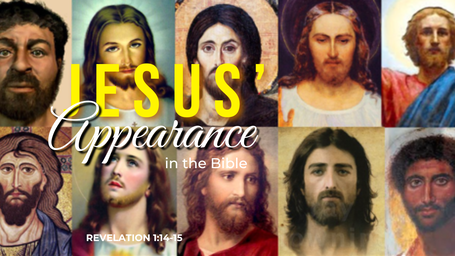
Jesus appearance
First, we have to be mindful that the Bible never described Jesus’ features like his height, weight, skin tone, eye color, or hair color. Yet, prophets like Isaiah did provide us with some insight into Jesus' physical appearance. See Isaiah 53:2. I would love to discuss this verse further, but this verse will require a separate lesson to explain it, which I don’t have the time to do so in this specific post. So let’s move on for now. However, feel free to research this verse for yourself.
As we know, in Western art, Jesus is the most commonly painted image. But the Western culture has always depicted Jesus as a bearded, fair-skinned man with long, wavy, light brown or blond hair with blue eyes. And yet, the Bible does not describe Jesus in this way.
So, what does the Bible reveal about Jesus’ features? Can we recreate an accurate depiction of Jesus' features from the scriptures? No, but we can come very close from what the Bible provides.
jesus nationality
We know that Jesus was of Jewish (Hebrew) descent. He was born in Bethlehem but raised in a town called Nazareth in Galilee. In Revelation chapter 1, verses 9 through 20, in the New King James Version, the subtitle is ‘Vision of the Son of Man.’ Now, we won’t read it all. Instead, we will focus on verses 14 through 15. (Also, read Matthew 17:2).
| His head and hair were white like wool, as white as snow, and his eyes like a flame of fire; His feet were like fine brass, as if refined in a furnace, and his voice as the sound of many waters. |
Now, what we have to be mindful of here is this depiction of Jesus given to Apostle John, which appeared to be an out-of-body experience. This description John sees of Jesus in verses 13 through 15 is a symbolic description [constituting a symbol or representation (which is a likeness or image of)]. So, when John described Jesus as having “… head and hair were white wool, as white as snow, and His eyes like flame of fire,” these were symbolic descriptions of Jesus as eternity, wisdom, and omniscience.
This depicts Jesus’ attributes and not necessarily his physical features. Therefore, what John was actually seeing and understanding about Jesus was the following.
This depicts Jesus’ attributes and not necessarily his physical features. Therefore, what John was actually seeing and understanding about Jesus was the following.
1. Jesus is eternity – infinite time. He has no end. Hence, verse 11 says, “I am the Alpha and the Omega, the First and the Last….”
2. He is wisdom. This is a wisdom that goes beyond intelligence or knowledge. But this is supreme intelligence. The kind of intelligence that belongs to GOD – something that man lacks.
3. Omniscience or omniscient – his state of being. Jesus possesses universal or complete knowledge. He is not lacking in anything. He is the eternal god that is all-knowing in that he knows everything. His knowledge and understanding in infinitely in that man cannot compete with or exceed or even obtain or grasp.
So, what we read at Revelation 1:14 is not a physical description of what Jesus looks like but a mere descriptive term describing his attributes so that mere man can comprehend the presence of their Savior.
The description we have of Jesus today is heavily influenced by Greek and Roman gods – particularly the Greek god Zeus. So, how do we know from the Scriptures what Jesus looked like? Go back to Revelation chapter 1, verses 12 through 16, John describes Jesus’ hair, eyes, feet, voice, and face, which is all symbolism. John provides a spiritual depiction of Jesus and not an actual physical description of his features – ethnicity or nationality.
Other descriptions we have of Jesus can be found at John 1:14.
| And the Word became flesh and dwelt among us…. |
So, when we take into account at Luke chapter 2, verses 1 through 20. Well, let’s explore that text.
We know that Caesar Augustus passed an edict requiring all to fulfill a census by registering to his own city. So, Joseph, Jesus’ earthy father, went from Galilee, out of the city of Nazareth, into Judea, to Bethlehem to register his family. At that time, Mary, Joseph’s wife, was pregnant with their first child, Jesus (the Son of GOD). While in Bethlehem, Mary gave birth to Jesus.
We know from historical records that Mary, Jesus’ mother, ethnicity (cultural characteristics that define people who belong to specific groups) and nationality (the legal perception of belonging to a specific nation – citizenship). She was of Jewish descent. Mary, as well as her husband, Joseph, were from the northern area of Galilee in Nazareth. Joseph’s house and lineage were of King David (Luke 2:4-5). We see this in the book of Matthew where he traces Jesus’ ancestry from Abraham through King David (Matthew 1:1-17). However, at Luke chapter 3, verses 23 through 38, his lineage is traced from Adam to GOD (Mary’s lineage). Therefore, when considering Abraham’s background, we know he was a Hebrew – “… Abram the Hebrew….” (Genesis 14:13). Jacob was an Israelite [same as a Jew (Genesis 35:10)]. One of Jacob’s sons is directly connected to the Messiah through Judah, which are of Jewish descent – descendants called Judeans, later called Jews.
Therefore, to get a close depicture of what Jesus looked like, we have to take into consideration the ethnicity, of his mother Mary. So, when considering all of this, we know, Jesus was born, lived, and died as a Jew. So, if we want to know what Jesus possibly looked like, all we have to do is turn to the Jewish community, in the region in which Jesus was born and raised. But even when doing so, we have to be mindful, that this will only give us a basic description of Jesus. For he was an average-looking man whose appearance didn’t stand out uniquely. In the scripture, it does not describe Jesus in modern superficial terms in an attempt to categorize his appearance. This was not important from GOD’s perspective. Jesus was just a regular, normal person of Jewish descent. It is as simple as that.

TO LISTEN TO THE AUDIO VERSION, CLICK THE VIDEO BELOW.
I sat on this word for a few days because I wanted to make sure this was something GOD wanted me to release. With that being said, here we go.
Let me point something out about myself that most of you don’t know. I am the kind of person who likes to encourage, build up, and push people toward their purpose, their gift, their calling in GOD. I love to celebrate people regardless of what venture or avenue they choose, especially if, there’s a passion and that’s what a person is called to do. Therefore, I am not the kind of person who wants to shoot something down or be negative. I desire to give constructive criticism that is honest and positive.
The point is, that I love to encourage and edify individuals. It is my high, a pleasure for me to do so. But at times, I notice things that rattle my cage and leave me feeling perplexed and troubled. So, I want to address today in my blog post, this phrase, GOD IS DOPE.
popular t-shirt design
I have to be honest. Whenever I come across this t-shirt design, GOD IS DOPE, my spirit becomes very grieved. For a long time, I didn’t know why this t-shirt design upset me so, until on Monday, March 4, at 1:00 a.m.
I woke up in the middle of the night and this phrase immediately came to mind and my spirit was irritated at just the thought of it. So, I finally decided to do a word study on this word ‘DOPE,’ and this is what I learned.
I woke up in the middle of the night and this phrase immediately came to mind and my spirit was irritated at just the thought of it. So, I finally decided to do a word study on this word ‘DOPE,’ and this is what I learned.
etymology of dope
Now, let me start by saying that I get what the designer of this t-shirt is trying to say. But we as Christians have to be mindful that we cannot allow our culture – its practices, attitudes, behaviors, or language, to influence the way we act, communicate, or speak. We as Christians are supposed to influence our culture, not the other way around. And yet, today, our culture is doing just that. Influencing the way Christians think, act, communicate, and speak. Take, for example, our language. Whenever our culture describes anything as ‘good,’ it will say, ‘that’s bad.’ And when it describes something awesome, it will declare, ‘that is wicked.’
When we adapt to and adopt such dramatic changes in our communication style and then try to attach this type of lango to GOD, it misrepresents the pure meaning of our language, while causing much confusion, and distorts the image of a holy and righteous GOD. Case in point, the phrase GOD IS DOPE.
When you do a word study of its origin, you will learn that DOPE has a very diverse and interesting background. Like many words, it takes on many different meanings. Before we get into its slang use which is more widely acceptable today, let’s look at its true meaning.
Dope comes from the Dutch word doop, which means thick sauce during the early 1800s. But by the 1850s, this word starts to transcend from meaning a thick sauce to becoming a verbal insult. For instance, if someone called you dope, it meant that you were a stupid person. I think y’all see where I am going with this but let’s keep going.
By the 1900s and 2000s, the word transformed again and took on a new meaning. During this time frame, dope was attached to drugs like morphine, cocaine, heroin, and marijuana. But it wasn’t until the 1980s that it took on the meaning that we know it today. In the 1980s, hip-hop rap artists like OG Busy Bee and Grandmaster Flash forever changed the meaning of dope from its negative connotation into a positive one. They single-handedly change its meaning from something that wasn’t good to mean ‘excellent.’ From there, it was quickly adopted into the mainstream culture, infusing itself into every sphere, including the Christian community. For instance, dope came to mean ‘good news,’ or when a skateboarder landed a sick trick, or a basketball player performed some monster dump, or a nice sports car, etc. The use of this word is endless but very misleading.
So, let’s take this further, which I am sure some probably will take offense to what I am about to say next and not agree with my point of view. But when considering the word DOPE and making it an artwork on a t-shirt to describe our Creator, we are coming into agreement with society’s description of not only what the word means from our cultural perspective, but we are labeling GOD with that same description. This is what we are saying about our GOD through that particular t-shirt design.
GOD IS STUPID, EXCELLENT, A DOPE DEALING, DRUG HEAD.
So, on one hand, we are saying GOD is awesome. But then, on the other hand, we are saying HE is a drug dealer who believes anything goes. Do you see the confusion it can cause when marketing such a message as GOD IS DOPE? The mixed message we are conveying about GOD when we don’t give careful consideration to the message we display about the GOD we serve. Also, we have to ask ourselves, what message is this conveying about the Body of Christ as a whole, who is MADE IN GOD’S IMAGE? Are we too stupid, excellent, dope-dealing, drug heads?
As designers, we need to be careful about how we create artwork when portraying a holy and righteous GOD. At the same time, buyers, practically Christian consumers, need to be wise in their purchases.
I can go deeper and further this viewpoint but my goal is not to damage anyone’s reputation, gifts, or creative process. But we must bring to light whenever our creative work expresses a mixed message that doesn’t adequately represent our GOD. Because GOD certainly is not DOPE. HE is good, righteous, holy, merciful, gracious, immutable, omnipotent, perfect, love, faithful, etc.

Photo CR: Samluce
A very important message to the Body of Christ from HIS apostle.
So, all the leaders and King Herod who sought to have Jesus killed were dead. See Matthew chapter 2, verses 19 and 20.
So, all the leaders and King Herod who sought to have Jesus killed were dead. See Matthew chapter 2, verses 19 and 20.
Verse 19 – Now King Herod was dead
Verse 20 – The angel of the LORD spoke to Joseph, who was in Egypt with his family, and told him, “… those who sought the young child’s life are dead….”
Verse 20 – The angel of the LORD spoke to Joseph, who was in Egypt with his family, and told him, “… those who sought the young child’s life are dead….”
Recall, at Matthew chapter 2, verse 13, an angel of the LORD appeared to Joseph, Jesus’ father, in a dream and instructed Joseph to take his son, and his wife, Mary, and flee to Egypt. This was a divine instruction and protection GOD gave to Joseph that I discussed in my January 2 YouTube post – Divine Instruction, Provision, and Protection. To watch, click here.
Within the divine instructions that the angel of the LORD gave to Joseph, there was an additional set of directions. The angel of the LORD also said to Joseph, “… stay there (in Egypt) until I bring you word…” (Matthew 2:13). Therefore, it was extremely important that Joseph remain in Egypt until he heard from the angel of the LORD once again.
Within the divine instructions that the angel of the LORD gave to Joseph, there was an additional set of directions. The angel of the LORD also said to Joseph, “… stay there (in Egypt) until I bring you word…” (Matthew 2:13). Therefore, it was extremely important that Joseph remain in Egypt until he heard from the angel of the LORD once again.
what lesson can Joseph’s situation teach us today
There is a great lesson in Joseph’s story for us today. As we observe our surroundings today, everywhere we turn, the world around us is becoming extremely corrupted and dark. Matthew 24:12 explains it this way.
| “Because of the increase of wickedness, the love of most will grow cold” (NIV). The NLT says, “Sin will be rampant everywhere….” |
We see the above becoming a reality, as we consider the increase in lawlessness when a state or region has reached its fullness in corruption and evil, as we have noticed in such states as California and New York City. When the laws of the land no longer benefit nor help to improve the lives of their citizens, the heads of households must contemplate whether to stay or relocate his or her family to another region. We don’t want to overlook the factor that Joseph found himself in a similar situation concerning the welfare of his family. He had to choose to stay, to go, and if he goes, when and where.
Decisions like these should not be made without the divine direction of GOD. This is so important. Why? Remember the case of Elimelech’s family who was dwelling in the land of Bethlehem, Judah. A famine came and struck the entire land. So, without consulting thy LORD thy GOD, Elimelech decides to flee from his region and relocate his family to the region of Moab, in hopes of finding better resources and provisions for his family there (Ruth 1:1-2). What became of Elimelech’s family’s fate due to his untimely decision? Ruth chapter 1, verses 3, 5, 13, 20, and 21 explains.
Decisions like these should not be made without the divine direction of GOD. This is so important. Why? Remember the case of Elimelech’s family who was dwelling in the land of Bethlehem, Judah. A famine came and struck the entire land. So, without consulting thy LORD thy GOD, Elimelech decides to flee from his region and relocate his family to the region of Moab, in hopes of finding better resources and provisions for his family there (Ruth 1:1-2). What became of Elimelech’s family’s fate due to his untimely decision? Ruth chapter 1, verses 3, 5, 13, 20, and 21 explains.
| Then Elimelech, Naomi’s husband, died; and she was left, and her two sons…. Then both Mahlon and Chilion also died; so the woman survived her two sons and her husband…." She said, "… It grieves me very much for your sakes that the hand of the Lord has gone out against me! … Do not call me Naomi; call me Mara, for the Almighty has dealt very bitterly with me. I went out full, and the Lord has brought me home again empty. Why do you call me Naomi, since the Lord has testified against me, and the Almighty has afflicted me?” |
We see in these verses what can happen to a family’s livelihood when the heads of a household do not wait on the divine instructions from the LORD. Elimelech did not wait for directions from GOD concerning how best to deal with the famine that was in his land. Instead, he took it upon himself to relocate his family to a land that seemed to him to be more prosperous. The results?
| Verse 3 – Elimelech experienced an untimely death in the land where he relocated his family. Verse 5 – Then later, both of his sons, Mahlon and Chilion die, leaving the women alone to fend for themselves. Verse 13 – These losses were so great to Naomi, the wife of Elimelech, that she became depressed. She said to her two daughters-in-law, Ruth and Orpah, “… It grieves me very much for your sakes that the hand of the Lord has gone out against me!” Verses 20-21 – Upon returning home to Bethlehem, she said to family and friends. “… Do not call me Naomi; call me Mara, for the Almighty has dealt very bitterly with me. I went out full, and the Lord has brought me home again empty. Why do you call me Naomi, since the Lord has testified against me, and the Almighty has afflicted me?” |
Now, let’s compare Elimelech’s family’s outcome to Isaac’s. In Genesis chapter 26, we see a famine struck the land in which Isaac, the son of Abraham, was residing. Isaac was faced with the same circumstances as Elimelech – to go or to stay and if he went, where. But noticed an angel interfered in the plans of Isaac and provided him divine instructions. “Do not go down to Egypt; live in the land of which I shall tell you. Dwell in this land, and I will be with you and bless you…” (Genesis 26:2-3).
Did you see that? Don’t miss what just took place! GOD provided Isaac with divine instructions that came with divine protection, which led to divine provisions for him if he followed the divine plans of the LORD for his life. As a result, Isaac decides to stay in the land.
Now, despite there being a famine in the land, noticed how GOD kept HIS promise to Isaac. Starting with verse 12 to verse 14.
| Then Isaac sowed in that land, and reaped in the same year a hundredfold; and the Lord blessed him. The man began to prosper, and continued prospering until he became very prosperous; for he had possessions of flocks and possessions of herds and a great number of servants…. |
Isaac and his family prosper during a time of famine because Isaac, as the head of his household, chose to follow the divine plans of the LORD. Therefore, Isaac and his family did not suffer the same fate as Elimelech and his family.
This is a lesson we need to take to heart today as servants of the Most High GOD.
This is a lesson we need to take to heart today as servants of the Most High GOD.
how did it end for joseph
So, let’s now turn our attention back to Joseph's situation. As we recall, the men who sought to have Jesus killed were all dead (Matthew 2:19-20). So, the same angel of the LORD who divinely instructed Joseph in a dream to relocate to Egypt from Bethlehem returns to Joseph in another dream with new divine instructions. He instructs Joseph to take his family and move to the land of Israel (verse 20). As Joseph contemplates the angel’s instructions, Joseph is aware of the problems that occurred in Judea.
| SIDEBAR: After the death of King Herod I, his rulership was divided up among his three sons – Archelaus, Antipas, and Philip. Initially, King Herod assigned his youngest son, Antipas as his successor. But upon his death bed, he changed it to his son Archelaus, to which, his brothers challenged their father’s change to Caesar Augustus. Caesar divided the region among the brothers, which left Archelaus overseeing 3 areas – Samaria, Judea, and Idumea (non-Jewish regions). Over time, Archelaus loses favor with the Jewish people during an uprise situation when Archelaus’ men lose control over a Jewish gathering during a Passover event. Some Jews rose up and stoned some of Archelaus’ men who were there for crowd control. [(Is this starting to sound somewhat familiar to the so-called January 6 insurrection attack on the Capital?) “There is nothing new under the sun” (Ecclesiastes 1:9)]. In response to this insurrection, Archelaus sent his entire army to regain control over the crowd, which resulted in 3,000 Jews being massacred. This triggered a delegation to form to plead to Caesar Augustus to have Archelaus removed. Once Archelaus learned of the delegation's actions, he retaliated by having the men of the delegation tracked down and killed along with their families. |
Joseph was aware of such atrocities that occurred under Archelaus’ rulership. So as he contemplated the angel of the LORD’s instructions to relocate his family to Israel. He knew if he moved his family to Judea, and if Archelaus became aware of Jesus as the next king of the Jews, whom his father, Herod I, was unsuccessful in killing, it might put Jesus’ life at risk. So he decided instead of going to Judea to relocate his family to the region of Galilee and establish his family in Nazarene. This act by Joseph kept him and his family aligned with GOD’s divine plans for him and his family. Furthermore, Joseph was able to fulfill the words spoken by GOD’s prophets years prior, in which they proclaimed that Jesus would be called a Nazarene (Matthew 2:23; compare to Isaiah 11:1; Zechariah 6:12).
our lesson today
The lesson we can learn from these events and the decisions made by Elimelech, Isaac, and Joseph concerning the welfare of their families is that it is important to look to GOD for all instructions and direction on behalf of our family before choosing to uproot our family from any region. For our divine protection and divine provisions (HIS blessings) will only be provided by GOD, IF we are in the divine place that GOD has called us.
other resources
Stay Series by Felicia Crawford Ministry. To watch, click the picture below.


This was the word of the LORD spoke to me. “Read my word and read it clear. May it enter your ears and it gives you insight and understanding,” says the LORD.
So, this is what the word of the LORD said at Ezra chapter 4, starting with verse 1.
So, this is what the word of the LORD said at Ezra chapter 4, starting with verse 1.
| Now when the adversaries of Judah and Benjamin heard that the descendants of the captivity were building the temple of the LORD God of Israel, they came to Zerubbabel and the heads of the fathers’ houses, and said to them, “Let us build with you, for we seek your God as you do; and we have sacrificed to Him since the days of Esarhaddon king of Assyria, who brought us here.” |
Now, you must ask yourself. How did these men become aware of Zerubbabel’s building plan? And why did they wait until Zerubbabel had all the materials, resources, and finances needed to THEN want to be a part of the plans of the LORD was doing through Zerubbabel?
You see, there will be those speculators who will sit back and watch you work hard in your grassroots stage. They will watch you attempt to grow networks with different folks, see your challenges in raising funds, and observe you struggling to promote and market your product or service. They will watch you rise and fall and not lift a finger or a voice to advocate or aid in supporting your efforts or struggles – the infancy and challenging years of your building plans. But the very moment when everything comes together. When you ascertain all the money you need, the fanfare has arrived in all its glory, and all the materials and resources you can dream of have finally come. Then the BOTTOM FEEDERS arrive in their flame of glory, riding their white horse offering to help while declaring we are one and the same – “… we seek your God…,” we too sacrifice to the same GOD.
You see, there will be those speculators who will sit back and watch you work hard in your grassroots stage. They will watch you attempt to grow networks with different folks, see your challenges in raising funds, and observe you struggling to promote and market your product or service. They will watch you rise and fall and not lift a finger or a voice to advocate or aid in supporting your efforts or struggles – the infancy and challenging years of your building plans. But the very moment when everything comes together. When you ascertain all the money you need, the fanfare has arrived in all its glory, and all the materials and resources you can dream of have finally come. Then the BOTTOM FEEDERS arrive in their flame of glory, riding their white horse offering to help while declaring we are one and the same – “… we seek your God…,” we too sacrifice to the same GOD.
how should you respond
But noticed Zerubbabel’s response to these men – these late arrivals in GOD’s plans through Zerubbabel. “But Zerubbabel and Jeshua and the rest of the heads of the fathers’ houses of Israel said to them, “You may do nothing with us to build a house for our God; but we alone will build to the LORD God of Israel…” (Ezra 4:3).
You see, most do not want to be a part of your growth and process until you have everything you need to finish the work you were called to do. Yet, they were present the entire time as a speculator only. At least not until they can see your work has definitely not failed. They will not move, advocate, lift a finger, or help to promote you until everything that needs to be done in the grassroots stage has been done. Then they will come running, acting as if they have been supportive cast members all along, while asking to join your building project. Then once you deny them access, they become offended and then make every effort to impede the work you were called to do just as they did in the case of Zerubbabel. The scripture reads “Then the people of the land tried to discourage the people of Judah. They troubled them in building and hired counselors against them to frustrate their purpose…” (Ezra 4:4-5).
Wow! The deceptive works of man.
But these men just didn’t stop there. They went as far as writing a letter to the highest office of the law and made unfounded and untruthful accusations against the building work, Zerubbabel, and the land. They made such claims that Zerubbabel’s building project was rebellious and evil. That once his work is done, he will not pay taxes or tributes that are due. What Zerubbabel and his men were doing would be harmful to the king’s provinces and it would lead to a sedition. Then they declared that it would be in the best interest of the king to cease their work because it would benefit no one.
Access denied
There is always that group of men and women watching as you are building. And at the most opportunist time, they will come to join your team just in time when all the hard work has been done and your success is guaranteed. Then they will offer to be a part of the plans of the LORD, to help build with you.
But, we must be wise as serpents and yet innocent as doves (Matthew 10:16). We must be faithful and loyal to those who were faithful to the plans of the LORD from the very beginning. Those who endured the grassroots stages with you. Those who remain faithful to you and your cause. Those who were able to see the vision and tap into it when it was nothing but an idea. Those who built with you the very first brick.
It is important to have no pity or sympathy for those bottom feeders who came late to the building plans. (Compare to Matthew 25). Give no place or voice to them. For they were disloyal to you as well as the building plans of the LORD through you.
Author
Thought-provoking Biblical topics. Talking Points with Deaidre.
And do not be conformed to this world [any longer with its superficial values and customs], but be transformed and progressively changed [as you mature spiritually] by the renewing of your mind [focusing on godly values and ethical attitudes], so that you may prove [for yourselves] what the will of God is, that which is good and acceptable and perfect [in His plan and purpose for you] (Romans 12:2 AMP).
Archives
September 2026
July 2026
October 2024
September 2024
April 2024
March 2024
January 2024
December 2023
November 2023
July 2023
June 2023
May 2023
April 2023
March 2023
February 2023
January 2023
December 2022
November 2022
October 2022
 RSS Feed