 · INTRODUCTION |


| SIDEBAR: Their agreement with the chief priests and elders concerning Jesus’ murder would later destroy the nation of Israel. History shows that shortly after the crowd declared, “His blood be on us and on our children,” Rome came and annihilated the nation. Jerusalem was destroyed, and the Temple was demolished and burned (Matthew 21:44; 23:38; 24:1–2). |
This was major. The people, the chief priests, and the elders called for the execution of a sinless man—the Son of God—and then placed judgment upon themselves and their children for their role in His death.
Note: The crowd did not have to be the ones who physically executed Jesus, like Pilate, the chief priests, or the elders. The fact that they agreed with His conviction made them partakers of God’s judgment. They placed themselves and their children under a curse (compare Matthew 27:25).
WHAT CAN WE LEARn
This article could conclude in many directions, but I want to focus on the outcome of the people whom the chief priests and elders persuaded to free Barabbas—the guilty criminal—and crucify Jesus—the innocent, sinless man. How their bad decision serves as both an example and a warning for us today.
This is what the Apostle Paul explained in 1 Corinthians 10:11: “These things happened to them as examples for us. They were written down to warn us who live at the end of the age” (NLT). In other words, when we repeat the same behaviors as those in the past, we will reap the same results. King Solomon expressed it this way: history merely repeats itself; what has been done before will be done again, and nothing under the sun is truly new.
We must be careful about declaring a person guilty of a crime—even when officials provide so‑called evidence. As Americans, we know our government is compromised and corrupt, just as the chief priests and elders were in Jesus’ day. As corrupt and envious men, they were determined to take the life of an innocent man. To achieve this, they had to convince the people to believe, support, and agree with their lies. They used their judicial system and governmental officials to distribute and promote deception. Once Jesus was arrested and processed through the Roman legal system, it became easier to convince the people that He was guilty of insurrection and blasphemy.
THE LESSON FOR TODAY
We must be very careful and wise about declaring whether a person is guilty. If we make the wrong decision about a soul, we can come under God’s judgment for taking the life of an innocent person.
Let’s revisit Matthew and read what the people said after agreeing with the chief priests and elders to have Jesus killed:
Let’s revisit Matthew and read what the people said after agreeing with the chief priests and elders to have Jesus killed:
| Pilate saw that he wasn’t getting anywhere and that a riot was developing. So he sent for a bowl of water and washed his hands before the crowd, saying, “I am innocent of this man’s blood. The responsibility is yours!” And all the people yelled back, “We will take responsibility for his death—we and our children! (Matthew 27:24-25) |
Ask yourself: Is this what you want? Judgment on yourself and your children for declaring an innocent man guilty of a crime he did not commit.

• Remember
• Reminders Are For Our Benefit
• A Holy Week Of Consecration
• Reminders Are For Our Benefit
• A Holy Week Of Consecration
It is important that we reflect on and remember the time when GOD’s people were once slaves in Egypt (Deuteronomy 16:12). Why is this important? Because just as it was important for the Israelites, it is important for us today to remember the time GOD’s people spent in bondage under the Egyptian regime, what that time was like for them, and who liberated them from it (Deuteronomy 15:15).
REMINDERS ARE FOR OUR BENEFIT
1 Corinthians 10:11 reads, “Now these things happened to them as an example and warning (to us); they were written for our instruction (to admonish and equip us), upon whom the ends of the ages have come."
We see the importance remembrance plays in our lives. This is why it is emphasized so often in the scriptures. The scriptures were written in such a way to help us recall events that occurred in places like Egypt, which later led to holy celebrations such as Sukkot.
We see the importance remembrance plays in our lives. This is why it is emphasized so often in the scriptures. The scriptures were written in such a way to help us recall events that occurred in places like Egypt, which later led to holy celebrations such as Sukkot.
A HOLY WEEK OF CONSECRATION
This week is a holy week that we need to consecrate to the LORD. Our focus needs to be completely on HIM by remembering what HE has brought us out of. Did HE free you from addiction, a self-destructive lifestyle, a bad relationship, financial difficulties, prison, a death sentence, etc.? Whatever it is, like the Israelites who once found themselves in bondage under Egyptian rule, we need to reflect on their time there as well as our personal time in bondage, and recall what GOD did not only for the Israelites to redeem them, but also what HE has done for us personally to free us from our own bondage.
Let this be our focus for the next three days leading up to the Holy Day celebration of Sukkot (October 16-23).
Let this be our focus for the next three days leading up to the Holy Day celebration of Sukkot (October 16-23).

- Persecution Is Coming
- Ravenous Wolves
- Be Prepared
- Despite Persecution There Is Hope
- There Is Hope In Christ
persecution is coming
In ministry comes a heavy mission and responsibility. We, as disciples of Christ, cannot be naïve. As ministers of Christ, we will all face some form of persecution as the end of this age draws near.
In fulfilling our commission, we are certain to encounter rejection and division. Yet, Jesus will give us the strength, wisdom, and even the words we may need to speak whenever we are faced with any form of opposition to the gospel, if we trust Him. That is the key. We must trust everything Jesus has said to us in the Holy Scriptures concerning what He has promised to do when we experience persecution.
In this season, it is essential that we are not cynical concerning our ministry, for such a mentality will not help us endure the things that will come. For Christ has sent us out as sheep in the midst of wolves (Matthew 10:16).
Jesus understood that His disciples would have a hard road before them—that they would suffer as He did. Hence, He said, “A student is not greater than his teacher. A servant is not above his master” (Matthew 10:24-25). Therefore, the student will share in his teacher’s fate.
A student of Christ should not only expect persecution but be prepared for it. They should be able to bear through it and continue their Kingdom work in the midst of persecution.
ravenous wolves
In our society, wicked men are likened to wolves. Their goal is to conquer, devour, and destroy (John 10:10). God's people are easy prey among them because they are like sheep among wolves. Although the trials they will face will be frightening, they can rest assured that Christ will be with them to comfort, protect, and help His disciples bear whatever comes their way.
be prepared
Part of helping them to be prepared is Christ telling His disciples what they should expect to experience.
- They will be hated. Those whom Christ loves, the world will hate without cause (John 15:25). The Apostle Paul describes it this way: Christ’s disciples will become like the scum of the world, the dregs of all things (1 Corinthians 4:13). A Christian’s existence will make them noxious to the world. They will become objects of persecutors' ill-will because of the name Christians represent. It is for His name’s sake that Christians will encounter such hatred.
- They will be delivered to authorities. As a result, Christ’s disciples will be handed over to aldermen—elected members of municipal councils—or to justices—members of the Supreme Court. Christ’s disciples will experience all kinds of injustices under the guise of law and justice. King Solomon states, “…in the place of justice, there is wickedness, and in the place of righteousness, there is wickedness” (Ecclesiastes 3:16). Because of the wickedness of man, Christ’s followers must expect to experience injustices not only from magistrates but also from governors, presidents, political figureheads, and supreme authorities. The Apostle Peter says it this way: “Be alert and cautious at all times. That enemy of yours, the devil, prowls around like a roaring lion (fiercely hungry), seeking someone to devour” (1 Peter 5:8, AMP).
- Some will even face death. Matthew 10:21 says, “Brother will betray brother to death, and a father his child; and children will rise up and rebel against their parents and cause them to be put to death.” The sad reality is that many will be put to death as criminals.
- They will be branded with odious and shameful names. They will be called names such as Beelzebub, the prince of demons (Matthew 10:25). They will be accused of being the ringleaders of the kingdom of darkness.
- Their suffering will also lead to division. Jesus said to His disciples, “Do not think I have come to bring peace on the earth. I have not come to bring peace, but a sword (division between belief and unbelief). For I have come to set a man against his father, a daughter against her mother, and a daughter-in-law against her mother-in-law” (Matthew 10:34-35).
despite persecution, there is hope
Although Christ’s disciples will suffer, there is hope. Jesus said, "He who endures to the end will be saved" (Matthew 10:22). Therefore, we should not fear those who can kill the body but cannot kill the soul (Matthew 10:26, 28).
there’s hope in christ
Despite the persecution, there is hope in Christ. We must be mindful that our persecution serves a Kingdom purpose. Verse 18 of Matthew chapter 10 states that it is a testimony (evidence) to the persecutor and the Gentile nations, bearing witness to the truth and its glorious effect. Who would have guessed that our suffering could represent the beauty of the good news? Our suffering is for the greatest name on earth. We suffer for His name’s sake.
Despite this suffering, our hope rests in Him. Enduring such tumultuous times will guarantee us the privilege of being saved by the only one who can rescue us (Matthew 10:22b, 28).
We must remember that we, as God’s creation, are worth more than sparrows. The Lord God provides for, protects, and takes care of all of them. We are worth more than these (Matthew 10:29). The hairs of our head are numbered—every strand. He knows exactly how many strands rest on our head.

Sukkot, also called the Harvest Festival and the Festival of Booths, is around the corner—October 16 through 23. We are looking forward to our annual family gathering, where we celebrate the gathering of the harvest and commemorate the miraculous protection God provided, not only for the children of Israel when they left Egypt, but also for the protection He provides for us as the Body of Christ in our preparation for exiting this world.
WHY WE SHOULD CONSIDER CELEBRATING SUKKOT
The Torah (the five books of Moses in the Bible), which contains the entire body of Jewish law, practice, and tradition, refers to Sukkot as Chag HaAsif or the Festival of Ingathering or Harvest Festival. It is sometimes called Chag HaSukkot – Festival of Booths.
Tradition holds that Israel grew its crops in the winter, and they were ready to harvest by late spring. During Chag HaAsif, it is a time when Israel expresses their appreciation for the bounty they have harvested.
Chag HaSukkot also refers to the temporary dwellings that God used to shelter the Israelites on their way out of Egypt.

HOW TO CELEBRATE SUKKOT
The first two days:
- Sundown on October 16 until nightfall on October 18 are Yom Tov (festive days).
The intermediate days:
- Nightfall on October 18 until sundown on October 23 are quasi-holy days called Chol Hamoed, which includes the festivals of Passover and Sukkot.
During this time, the Israelites dwelt in a Sukkah—a hut or booth roofed with vegetation, in which the autumn festival of Sukkot is observed.
Although our family will not observe these holy days exactly in the same manner as the Israelites, we will incorporate some aspects of it. For instance, we will provide our own version of the Sukkah, which will be an outdoor tent.
The final two days:
- Sundown on October 23 until nightfall on October 25 are separate celebrations: Shemini Atzeret/Simchat Torah.
We look forward to everyone being present, so mark it on your calendar! If you have any questions about the event schedule, kids' activities, or meals being served, contact Kne’Elle. For questions about the festival or related scripture, contact Felicia.
See everyone there!
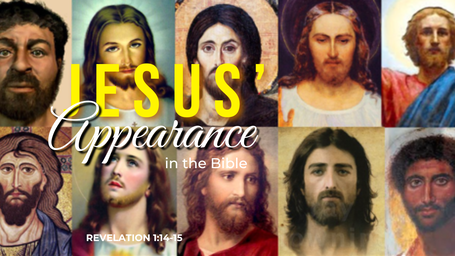
I received an interesting question from one of my Bible students whom I mostly communicate via text message. (We occasionally talk by phone).
The question was asked concerning Jesus.
The question was asked concerning Jesus.
| “To me, he (Jesus) is faceless. But when I saw the normal picture of the public, I accepted cause to me all I ever knew was a spirit, a feeling of calm when I prayed for help. And normally it came. So, I said, whatever rocks whomever’s boat. LOL. I thought maybe an Arabic?” |
Before I get into the answer I shared with my Bible student, let me explain what led to this conversation about Jesus’ appearance.
our discussion
This student texted me a picture of three young girls on the street, at a restaurant, drinking coffee. The instructions on the picture said, “Close your eyes and then barely open them.” So, I did. And when I did, the image showed a depiction of Jesus. Well, what most people think he looks like.
So, I responded in awe and then said, “You know, that’s not what Jesus looked like.” That statement led to her comment above. To which I responded, “… The Bible does describe what he looks like. And it's not some European white man, nor a black man either.” She responded that Jesus was probably an Arabic. To which I said, “Not exactly, but close. He was a Jew, a Hebrew.”
She then said, “Oh, that is right – a Jew!” Then she asked, “Do you know where the Bible describes him? On The Chosen, he doesn’t look Jewish to me.” This question brings us to today’s post.
Since this is not the first time I’ve had this type of conversation while informal witnessing to a person. I thought it would be a good idea to put this topic in written form to share with you – my readers. But mainly because I have had this kind of discussion with other Bible students in the past with whom I either did not do a good job explaining at the time. Or, I failed or did not have an opportunity to explain or answer their inquiry. So, I want to use this time to correct that so I can forward this post to other Bible students.
Jesus appearance
First, we have to be mindful that the Bible never described Jesus’ features like his height, weight, skin tone, eye color, or hair color. Yet, prophets like Isaiah did provide us with some insight into Jesus' physical appearance. See Isaiah 53:2. I would love to discuss this verse further, but this verse will require a separate lesson to explain it, which I don’t have the time to do so in this specific post. So let’s move on for now. However, feel free to research this verse for yourself.
As we know, in Western art, Jesus is the most commonly painted image. But the Western culture has always depicted Jesus as a bearded, fair-skinned man with long, wavy, light brown or blond hair with blue eyes. And yet, the Bible does not describe Jesus in this way.
So, what does the Bible reveal about Jesus’ features? Can we recreate an accurate depiction of Jesus' features from the scriptures? No, but we can come very close from what the Bible provides.
jesus nationality
We know that Jesus was of Jewish (Hebrew) descent. He was born in Bethlehem but raised in a town called Nazareth in Galilee. In Revelation chapter 1, verses 9 through 20, in the New King James Version, the subtitle is ‘Vision of the Son of Man.’ Now, we won’t read it all. Instead, we will focus on verses 14 through 15. (Also, read Matthew 17:2).
| His head and hair were white like wool, as white as snow, and his eyes like a flame of fire; His feet were like fine brass, as if refined in a furnace, and his voice as the sound of many waters. |
Now, what we have to be mindful of here is this depiction of Jesus given to Apostle John, which appeared to be an out-of-body experience. This description John sees of Jesus in verses 13 through 15 is a symbolic description [constituting a symbol or representation (which is a likeness or image of)]. So, when John described Jesus as having “… head and hair were white wool, as white as snow, and His eyes like flame of fire,” these were symbolic descriptions of Jesus as eternity, wisdom, and omniscience.
This depicts Jesus’ attributes and not necessarily his physical features. Therefore, what John was actually seeing and understanding about Jesus was the following.
This depicts Jesus’ attributes and not necessarily his physical features. Therefore, what John was actually seeing and understanding about Jesus was the following.
1. Jesus is eternity – infinite time. He has no end. Hence, verse 11 says, “I am the Alpha and the Omega, the First and the Last….”
2. He is wisdom. This is a wisdom that goes beyond intelligence or knowledge. But this is supreme intelligence. The kind of intelligence that belongs to GOD – something that man lacks.
3. Omniscience or omniscient – his state of being. Jesus possesses universal or complete knowledge. He is not lacking in anything. He is the eternal god that is all-knowing in that he knows everything. His knowledge and understanding in infinitely in that man cannot compete with or exceed or even obtain or grasp.
So, what we read at Revelation 1:14 is not a physical description of what Jesus looks like but a mere descriptive term describing his attributes so that mere man can comprehend the presence of their Savior.
The description we have of Jesus today is heavily influenced by Greek and Roman gods – particularly the Greek god Zeus. So, how do we know from the Scriptures what Jesus looked like? Go back to Revelation chapter 1, verses 12 through 16, John describes Jesus’ hair, eyes, feet, voice, and face, which is all symbolism. John provides a spiritual depiction of Jesus and not an actual physical description of his features – ethnicity or nationality.
Other descriptions we have of Jesus can be found at John 1:14.
| And the Word became flesh and dwelt among us…. |
So, when we take into account at Luke chapter 2, verses 1 through 20. Well, let’s explore that text.
We know that Caesar Augustus passed an edict requiring all to fulfill a census by registering to his own city. So, Joseph, Jesus’ earthy father, went from Galilee, out of the city of Nazareth, into Judea, to Bethlehem to register his family. At that time, Mary, Joseph’s wife, was pregnant with their first child, Jesus (the Son of GOD). While in Bethlehem, Mary gave birth to Jesus.
We know from historical records that Mary, Jesus’ mother, ethnicity (cultural characteristics that define people who belong to specific groups) and nationality (the legal perception of belonging to a specific nation – citizenship). She was of Jewish descent. Mary, as well as her husband, Joseph, were from the northern area of Galilee in Nazareth. Joseph’s house and lineage were of King David (Luke 2:4-5). We see this in the book of Matthew where he traces Jesus’ ancestry from Abraham through King David (Matthew 1:1-17). However, at Luke chapter 3, verses 23 through 38, his lineage is traced from Adam to GOD (Mary’s lineage). Therefore, when considering Abraham’s background, we know he was a Hebrew – “… Abram the Hebrew….” (Genesis 14:13). Jacob was an Israelite [same as a Jew (Genesis 35:10)]. One of Jacob’s sons is directly connected to the Messiah through Judah, which are of Jewish descent – descendants called Judeans, later called Jews.
Therefore, to get a close depicture of what Jesus looked like, we have to take into consideration the ethnicity, of his mother Mary. So, when considering all of this, we know, Jesus was born, lived, and died as a Jew. So, if we want to know what Jesus possibly looked like, all we have to do is turn to the Jewish community, in the region in which Jesus was born and raised. But even when doing so, we have to be mindful, that this will only give us a basic description of Jesus. For he was an average-looking man whose appearance didn’t stand out uniquely. In the scripture, it does not describe Jesus in modern superficial terms in an attempt to categorize his appearance. This was not important from GOD’s perspective. Jesus was just a regular, normal person of Jewish descent. It is as simple as that.

TO LISTEN TO THE AUDIO VERSION, CLICK THE VIDEO BELOW.
I sat on this word for a few days because I wanted to make sure this was something GOD wanted me to release. With that being said, here we go.
Let me point something out about myself that most of you don’t know. I am the kind of person who likes to encourage, build up, and push people toward their purpose, their gift, their calling in GOD. I love to celebrate people regardless of what venture or avenue they choose, especially if, there’s a passion and that’s what a person is called to do. Therefore, I am not the kind of person who wants to shoot something down or be negative. I desire to give constructive criticism that is honest and positive.
The point is, that I love to encourage and edify individuals. It is my high, a pleasure for me to do so. But at times, I notice things that rattle my cage and leave me feeling perplexed and troubled. So, I want to address today in my blog post, this phrase, GOD IS DOPE.
popular t-shirt design
I have to be honest. Whenever I come across this t-shirt design, GOD IS DOPE, my spirit becomes very grieved. For a long time, I didn’t know why this t-shirt design upset me so, until on Monday, March 4, at 1:00 a.m.
I woke up in the middle of the night and this phrase immediately came to mind and my spirit was irritated at just the thought of it. So, I finally decided to do a word study on this word ‘DOPE,’ and this is what I learned.
I woke up in the middle of the night and this phrase immediately came to mind and my spirit was irritated at just the thought of it. So, I finally decided to do a word study on this word ‘DOPE,’ and this is what I learned.
etymology of dope
Now, let me start by saying that I get what the designer of this t-shirt is trying to say. But we as Christians have to be mindful that we cannot allow our culture – its practices, attitudes, behaviors, or language, to influence the way we act, communicate, or speak. We as Christians are supposed to influence our culture, not the other way around. And yet, today, our culture is doing just that. Influencing the way Christians think, act, communicate, and speak. Take, for example, our language. Whenever our culture describes anything as ‘good,’ it will say, ‘that’s bad.’ And when it describes something awesome, it will declare, ‘that is wicked.’
When we adapt to and adopt such dramatic changes in our communication style and then try to attach this type of lango to GOD, it misrepresents the pure meaning of our language, while causing much confusion, and distorts the image of a holy and righteous GOD. Case in point, the phrase GOD IS DOPE.
When you do a word study of its origin, you will learn that DOPE has a very diverse and interesting background. Like many words, it takes on many different meanings. Before we get into its slang use which is more widely acceptable today, let’s look at its true meaning.
Dope comes from the Dutch word doop, which means thick sauce during the early 1800s. But by the 1850s, this word starts to transcend from meaning a thick sauce to becoming a verbal insult. For instance, if someone called you dope, it meant that you were a stupid person. I think y’all see where I am going with this but let’s keep going.
By the 1900s and 2000s, the word transformed again and took on a new meaning. During this time frame, dope was attached to drugs like morphine, cocaine, heroin, and marijuana. But it wasn’t until the 1980s that it took on the meaning that we know it today. In the 1980s, hip-hop rap artists like OG Busy Bee and Grandmaster Flash forever changed the meaning of dope from its negative connotation into a positive one. They single-handedly change its meaning from something that wasn’t good to mean ‘excellent.’ From there, it was quickly adopted into the mainstream culture, infusing itself into every sphere, including the Christian community. For instance, dope came to mean ‘good news,’ or when a skateboarder landed a sick trick, or a basketball player performed some monster dump, or a nice sports car, etc. The use of this word is endless but very misleading.
So, let’s take this further, which I am sure some probably will take offense to what I am about to say next and not agree with my point of view. But when considering the word DOPE and making it an artwork on a t-shirt to describe our Creator, we are coming into agreement with society’s description of not only what the word means from our cultural perspective, but we are labeling GOD with that same description. This is what we are saying about our GOD through that particular t-shirt design.
GOD IS STUPID, EXCELLENT, A DOPE DEALING, DRUG HEAD.
So, on one hand, we are saying GOD is awesome. But then, on the other hand, we are saying HE is a drug dealer who believes anything goes. Do you see the confusion it can cause when marketing such a message as GOD IS DOPE? The mixed message we are conveying about GOD when we don’t give careful consideration to the message we display about the GOD we serve. Also, we have to ask ourselves, what message is this conveying about the Body of Christ as a whole, who is MADE IN GOD’S IMAGE? Are we too stupid, excellent, dope-dealing, drug heads?
As designers, we need to be careful about how we create artwork when portraying a holy and righteous GOD. At the same time, buyers, practically Christian consumers, need to be wise in their purchases.
I can go deeper and further this viewpoint but my goal is not to damage anyone’s reputation, gifts, or creative process. But we must bring to light whenever our creative work expresses a mixed message that doesn’t adequately represent our GOD. Because GOD certainly is not DOPE. HE is good, righteous, holy, merciful, gracious, immutable, omnipotent, perfect, love, faithful, etc.

Photo CR: Samluce
A very important message to the Body of Christ from HIS apostle.
So, all the leaders and King Herod who sought to have Jesus killed were dead. See Matthew chapter 2, verses 19 and 20.
So, all the leaders and King Herod who sought to have Jesus killed were dead. See Matthew chapter 2, verses 19 and 20.
Verse 19 – Now King Herod was dead
Verse 20 – The angel of the LORD spoke to Joseph, who was in Egypt with his family, and told him, “… those who sought the young child’s life are dead….”
Verse 20 – The angel of the LORD spoke to Joseph, who was in Egypt with his family, and told him, “… those who sought the young child’s life are dead….”
Recall, at Matthew chapter 2, verse 13, an angel of the LORD appeared to Joseph, Jesus’ father, in a dream and instructed Joseph to take his son, and his wife, Mary, and flee to Egypt. This was a divine instruction and protection GOD gave to Joseph that I discussed in my January 2 YouTube post – Divine Instruction, Provision, and Protection. To watch, click here.
Within the divine instructions that the angel of the LORD gave to Joseph, there was an additional set of directions. The angel of the LORD also said to Joseph, “… stay there (in Egypt) until I bring you word…” (Matthew 2:13). Therefore, it was extremely important that Joseph remain in Egypt until he heard from the angel of the LORD once again.
Within the divine instructions that the angel of the LORD gave to Joseph, there was an additional set of directions. The angel of the LORD also said to Joseph, “… stay there (in Egypt) until I bring you word…” (Matthew 2:13). Therefore, it was extremely important that Joseph remain in Egypt until he heard from the angel of the LORD once again.
what lesson can Joseph’s situation teach us today
There is a great lesson in Joseph’s story for us today. As we observe our surroundings today, everywhere we turn, the world around us is becoming extremely corrupted and dark. Matthew 24:12 explains it this way.
| “Because of the increase of wickedness, the love of most will grow cold” (NIV). The NLT says, “Sin will be rampant everywhere….” |
We see the above becoming a reality, as we consider the increase in lawlessness when a state or region has reached its fullness in corruption and evil, as we have noticed in such states as California and New York City. When the laws of the land no longer benefit nor help to improve the lives of their citizens, the heads of households must contemplate whether to stay or relocate his or her family to another region. We don’t want to overlook the factor that Joseph found himself in a similar situation concerning the welfare of his family. He had to choose to stay, to go, and if he goes, when and where.
Decisions like these should not be made without the divine direction of GOD. This is so important. Why? Remember the case of Elimelech’s family who was dwelling in the land of Bethlehem, Judah. A famine came and struck the entire land. So, without consulting thy LORD thy GOD, Elimelech decides to flee from his region and relocate his family to the region of Moab, in hopes of finding better resources and provisions for his family there (Ruth 1:1-2). What became of Elimelech’s family’s fate due to his untimely decision? Ruth chapter 1, verses 3, 5, 13, 20, and 21 explains.
Decisions like these should not be made without the divine direction of GOD. This is so important. Why? Remember the case of Elimelech’s family who was dwelling in the land of Bethlehem, Judah. A famine came and struck the entire land. So, without consulting thy LORD thy GOD, Elimelech decides to flee from his region and relocate his family to the region of Moab, in hopes of finding better resources and provisions for his family there (Ruth 1:1-2). What became of Elimelech’s family’s fate due to his untimely decision? Ruth chapter 1, verses 3, 5, 13, 20, and 21 explains.
| Then Elimelech, Naomi’s husband, died; and she was left, and her two sons…. Then both Mahlon and Chilion also died; so the woman survived her two sons and her husband…." She said, "… It grieves me very much for your sakes that the hand of the Lord has gone out against me! … Do not call me Naomi; call me Mara, for the Almighty has dealt very bitterly with me. I went out full, and the Lord has brought me home again empty. Why do you call me Naomi, since the Lord has testified against me, and the Almighty has afflicted me?” |
We see in these verses what can happen to a family’s livelihood when the heads of a household do not wait on the divine instructions from the LORD. Elimelech did not wait for directions from GOD concerning how best to deal with the famine that was in his land. Instead, he took it upon himself to relocate his family to a land that seemed to him to be more prosperous. The results?
| Verse 3 – Elimelech experienced an untimely death in the land where he relocated his family. Verse 5 – Then later, both of his sons, Mahlon and Chilion die, leaving the women alone to fend for themselves. Verse 13 – These losses were so great to Naomi, the wife of Elimelech, that she became depressed. She said to her two daughters-in-law, Ruth and Orpah, “… It grieves me very much for your sakes that the hand of the Lord has gone out against me!” Verses 20-21 – Upon returning home to Bethlehem, she said to family and friends. “… Do not call me Naomi; call me Mara, for the Almighty has dealt very bitterly with me. I went out full, and the Lord has brought me home again empty. Why do you call me Naomi, since the Lord has testified against me, and the Almighty has afflicted me?” |
Now, let’s compare Elimelech’s family’s outcome to Isaac’s. In Genesis chapter 26, we see a famine struck the land in which Isaac, the son of Abraham, was residing. Isaac was faced with the same circumstances as Elimelech – to go or to stay and if he went, where. But noticed an angel interfered in the plans of Isaac and provided him divine instructions. “Do not go down to Egypt; live in the land of which I shall tell you. Dwell in this land, and I will be with you and bless you…” (Genesis 26:2-3).
Did you see that? Don’t miss what just took place! GOD provided Isaac with divine instructions that came with divine protection, which led to divine provisions for him if he followed the divine plans of the LORD for his life. As a result, Isaac decides to stay in the land.
Now, despite there being a famine in the land, noticed how GOD kept HIS promise to Isaac. Starting with verse 12 to verse 14.
| Then Isaac sowed in that land, and reaped in the same year a hundredfold; and the Lord blessed him. The man began to prosper, and continued prospering until he became very prosperous; for he had possessions of flocks and possessions of herds and a great number of servants…. |
Isaac and his family prosper during a time of famine because Isaac, as the head of his household, chose to follow the divine plans of the LORD. Therefore, Isaac and his family did not suffer the same fate as Elimelech and his family.
This is a lesson we need to take to heart today as servants of the Most High GOD.
This is a lesson we need to take to heart today as servants of the Most High GOD.
how did it end for joseph
So, let’s now turn our attention back to Joseph's situation. As we recall, the men who sought to have Jesus killed were all dead (Matthew 2:19-20). So, the same angel of the LORD who divinely instructed Joseph in a dream to relocate to Egypt from Bethlehem returns to Joseph in another dream with new divine instructions. He instructs Joseph to take his family and move to the land of Israel (verse 20). As Joseph contemplates the angel’s instructions, Joseph is aware of the problems that occurred in Judea.
| SIDEBAR: After the death of King Herod I, his rulership was divided up among his three sons – Archelaus, Antipas, and Philip. Initially, King Herod assigned his youngest son, Antipas as his successor. But upon his death bed, he changed it to his son Archelaus, to which, his brothers challenged their father’s change to Caesar Augustus. Caesar divided the region among the brothers, which left Archelaus overseeing 3 areas – Samaria, Judea, and Idumea (non-Jewish regions). Over time, Archelaus loses favor with the Jewish people during an uprise situation when Archelaus’ men lose control over a Jewish gathering during a Passover event. Some Jews rose up and stoned some of Archelaus’ men who were there for crowd control. [(Is this starting to sound somewhat familiar to the so-called January 6 insurrection attack on the Capital?) “There is nothing new under the sun” (Ecclesiastes 1:9)]. In response to this insurrection, Archelaus sent his entire army to regain control over the crowd, which resulted in 3,000 Jews being massacred. This triggered a delegation to form to plead to Caesar Augustus to have Archelaus removed. Once Archelaus learned of the delegation's actions, he retaliated by having the men of the delegation tracked down and killed along with their families. |
Joseph was aware of such atrocities that occurred under Archelaus’ rulership. So as he contemplated the angel of the LORD’s instructions to relocate his family to Israel. He knew if he moved his family to Judea, and if Archelaus became aware of Jesus as the next king of the Jews, whom his father, Herod I, was unsuccessful in killing, it might put Jesus’ life at risk. So he decided instead of going to Judea to relocate his family to the region of Galilee and establish his family in Nazarene. This act by Joseph kept him and his family aligned with GOD’s divine plans for him and his family. Furthermore, Joseph was able to fulfill the words spoken by GOD’s prophets years prior, in which they proclaimed that Jesus would be called a Nazarene (Matthew 2:23; compare to Isaiah 11:1; Zechariah 6:12).
our lesson today
The lesson we can learn from these events and the decisions made by Elimelech, Isaac, and Joseph concerning the welfare of their families is that it is important to look to GOD for all instructions and direction on behalf of our family before choosing to uproot our family from any region. For our divine protection and divine provisions (HIS blessings) will only be provided by GOD, IF we are in the divine place that GOD has called us.
other resources
Stay Series by Felicia Crawford Ministry. To watch, click the picture below.

Author
Thought-provoking Biblical topics. Talking Points with Deaidre.
And do not be conformed to this world [any longer with its superficial values and customs], but be transformed and progressively changed [as you mature spiritually] by the renewing of your mind [focusing on godly values and ethical attitudes], so that you may prove [for yourselves] what the will of God is, that which is good and acceptable and perfect [in His plan and purpose for you] (Romans 12:2 AMP).
Archives
October 2026
September 2026
July 2026
October 2024
September 2024
April 2024
March 2024
January 2024
December 2023
November 2023
July 2023
June 2023
May 2023
April 2023
March 2023
February 2023
January 2023
December 2022
November 2022
October 2022
 RSS Feed